


Understanding DTF Adhesive Powder

DTF adhesive powder is easy to overlook because customers never see it, but it is one of the most important parts of a finished transfer. The right powder application and curing process determine whether a design bonds evenly, stretches with the garment, and stays attached through repeated washing.
Understanding what the powder does helps apparel businesses press more consistently, diagnose failures faster, and choose transfers that perform reliably in production.
What Is DTF Adhesive Powder?
DTF adhesive powder is a heat-activated material that bonds DTF ink to fabric. Most DTF powders are based on thermoplastic polyurethane, commonly called TPU, although exact formulations vary by manufacturer and intended application.
During DTF production, a printer lays down colored ink on a coated film and then adds a layer of white ink. Adhesive powder is applied while that ink is still wet. The powder sticks to the printed areas, while excess powder is removed from the unprinted film.
The powdered transfer then passes through a curing process. Heat melts or gels the powder into a uniform adhesive layer without applying the transfer to a garment yet. When a shop later presses the finished transfer, the adhesive softens again, flows into the garment fibers, and forms the final bond as it cools.
Adhesive powder is part of a complete system
Powder cannot compensate for weak ink, poor film coating, incorrect curing, or an inaccurate heat press. A dependable DTF transfer requires the film, ink, powder, curing conditions, and application instructions to work together.
This is also why two transfers that look similar before pressing may perform very differently after washing. The adhesive layer is largely hidden behind the white ink, so visual inspection alone does not reveal its formulation, coverage, or cure quality.
Bear Transfers produces hot-peel transfers backed by a 100+ wash guarantee when they are applied and cared for as directed. Shops that want to evaluate color, feel, peeling, and application before a larger order can start with a DTF + UV DTF sample pack.
Why DTF Adhesive Powder Matters
The adhesive layer affects nearly every performance characteristic that matters to an apparel decorator. It must create enough grip to hold the design in place without making the print unnecessarily stiff or leaving adhesive outside the artwork.
| Performance factor | How the adhesive affects it | What a problem may look like |
|---|---|---|
| Bond strength | Anchors the cured ink to garment fibers | Edges lift or sections detach |
| Wash durability | Helps the design withstand laundering and movement | Cracking, peeling, or premature separation |
| Stretch and recovery | Allows the print to move with the fabric | Splits appear when the garment stretches |
| Hand feel | Contributes to the thickness and flexibility of the print | The design feels heavy, rigid, or rubbery |
| Edge quality | Should remain limited to printed areas | A rough adhesive halo surrounds the design |
Coverage must be complete but controlled
Too little adhesive can create weak spots, especially in fine details, solid areas, and design edges. Too much powder may increase the print's weight, reduce flexibility, or leave unwanted adhesive around the artwork.
A well-made transfer has consistent coverage across the complete printed area. It should not contain bare patches, loose powder, or thick clumps. Fine lines and small lettering are especially dependent on accurate powder coverage because there is less printed surface available to form a bond.
Powder particle size affects production
DTF powders are available in different particle ranges, often described as fine, medium, or coarse. Those labels are not standardized across every supplier, but particle size generally affects how easily the powder covers detail, flows during curing, and builds adhesive thickness.
- Finer powder can coat small details effectively but requires controlled handling and removal of excess material.
- Medium powder is commonly used as a versatile option for everyday apparel transfers.
- Coarser powder may build a heavier adhesive layer and may be selected for particular fabrics or production systems.
The best choice is not automatically the finest or strongest powder. It is the formulation tested with the specific printer, inks, film, curing equipment, and intended fabric.
How Powder and Curing Problems Show Up
Press operators rarely handle loose powder when buying ready-to-press transfers, but they still benefit from recognizing adhesive-related symptoms. Correct diagnosis prevents wasted garments and avoids repeatedly changing pressure or temperature when the transfer itself is the issue.
Edges lift after peeling
Edge lifting can result from incomplete adhesive coverage, but application conditions are often the first thing to check. Verify that the press reached the required temperature, pressure was even, the garment was pre-pressed, and the transfer was peeled according to its instructions.
If only one side or corner lifts, the heat press may have a cold area or uneven platen pressure. If fine details fail across multiple garments, transfer coverage or artwork construction may be involved.
The design has a grainy or rough outline
A rough halo can occur when powder remains on unprinted film and later melts onto the garment. This is different from a clean adhesive edge underneath the ink. Halos are particularly visible on dark or smooth fabrics, so inspect transfers under good lighting before running an entire order.
The print feels unusually thick
A heavy feel can come from dense artwork, large solid backgrounds, excessive white ink, or a thick adhesive layer. Artwork decisions matter: removing unnecessary backgrounds and using intentional negative space can improve breathability without weakening the design.
Efficient layout also protects the edges of each transfer before cutting. The guide to fixing gang sheet spacing, bleed, and rotation mistakes explains how to avoid crowded cuts and other preventable setup problems.
Peeling begins after washing
Delayed failure does not always mean the adhesive was defective. Under-pressing may create a bond that looks acceptable initially but lacks full fiber penetration. Washing too soon, using aggressive heat during drying, or stretching the print while it is hot can also reduce service life.
Follow the supplied press and care instructions rather than relying on one universal setting for every transfer. Press temperature displays can also drift, so a shop producing regular orders should verify platen temperature and pressure periodically.
How to Get a Reliable Bond in Your Shop
Consistent application starts with controlling the variables at the heat press. Use a repeatable workflow instead of adjusting settings based only on how the first print looks.
- Confirm the garment is compatible. Review the fabric content, coatings, seams, and heat sensitivity before production.
- Pre-press the application area. A short pre-press removes surface moisture and wrinkles while giving you a flat working area.
- Position the transfer accurately. Keep the complete design on a level section of the platen, away from collars, zippers, and thick seams.
- Use the transfer supplier's settings. Apply the specified time, temperature, pressure, and peel method instead of assuming all DTF products press identically.
- Complete any required finishing press. Use the recommended cover sheet or finishing method to secure the print and achieve the intended surface.
- Inspect before packing. Check fine details and edges after the garment cools, and follow the recommended waiting period before washing.
Garment stability matters too. Cotton and blended shirts may change slightly after laundering, which can affect placement and the way a print appears on the body. Review shrinkage and print placement after the first wash when choosing blanks and building placement standards.
If you need garments with your transfers, Bear Transfers offers blank apparel priced near cost. Testing the actual blank, transfer, and press settings together is the most dependable way to approve a new production combination.
Choosing DTF Transfers for Consistent Production
Most small apparel businesses do not need to select or store raw adhesive powder. Ordering professionally produced transfers removes powder handling, curing, and ventilation from the shop workflow while letting the decorator focus on artwork, placement, pressing, and fulfillment.
Choose an ordering format based on how you produce:
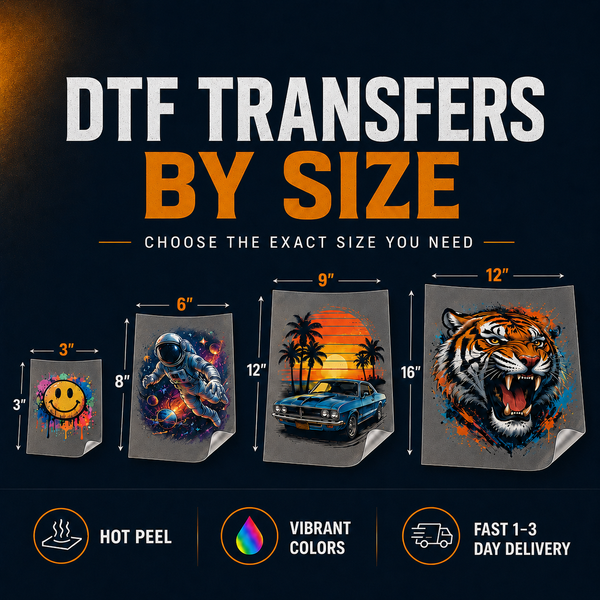
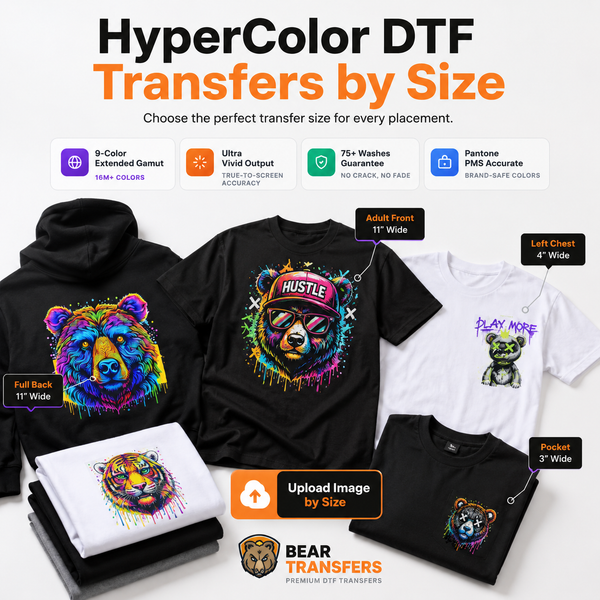
- Use DTF transfers ordered by size when you want individual designs prepared at specific dimensions.
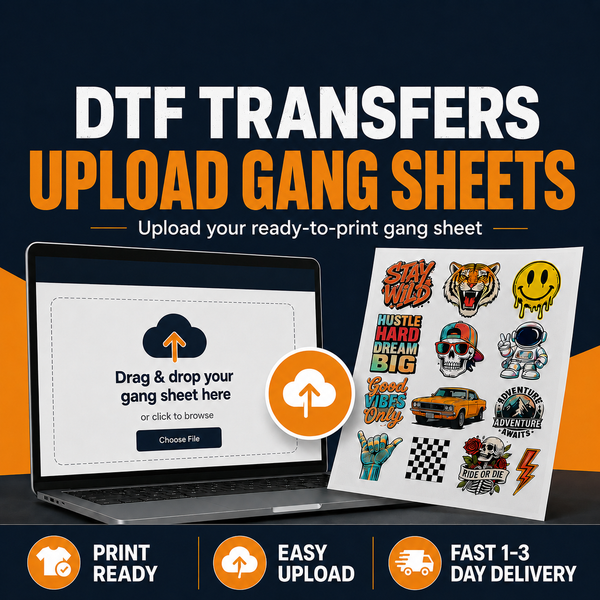
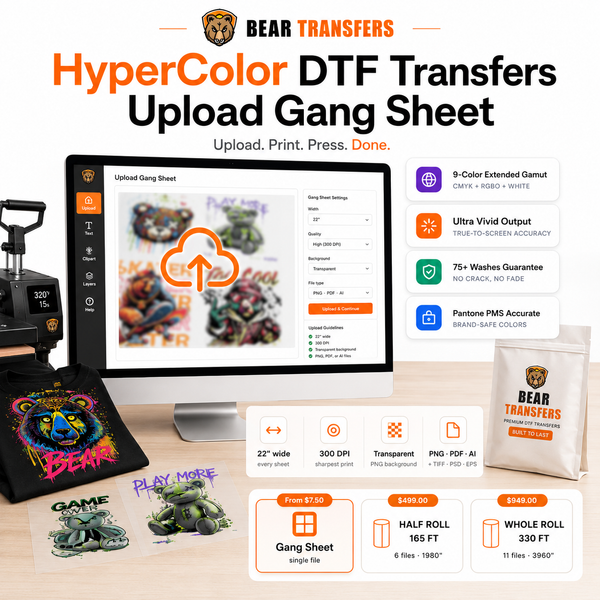
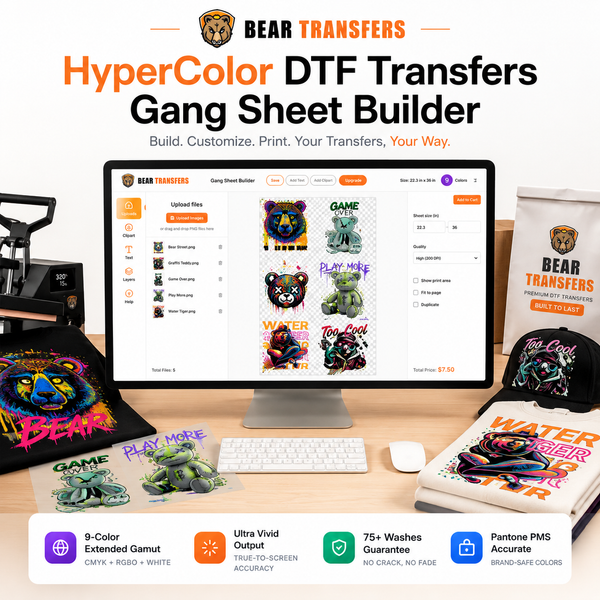
- Use the online gang sheet builder when combining multiple logos, names, or customer designs on one sheet.
- Choose HyperColor 9-color RGB DTF transfers for artwork that benefits from an expanded color workflow.
Bear Transfers offers DTF gang sheets from $2.58 per foot, with free shipping on orders over $99. Orders placed before the same-day production cutoff are produced that day, most orders ship within 24 hours, and UPS shipping typically takes one to three days.
Regardless of the ordering method, run a sample when introducing a new fabric, specialty garment, or high-volume job. Record the blank style, fabric content, press settings, peel method, and result so employees can reproduce the approved process.
FAQ
Is DTF adhesive powder visible on a finished shirt?
It should remain beneath the printed ink and should not be obvious around the design. Visible residue or a rough halo can indicate excess powder outside the printed area.
Can I use the same heat press settings for every DTF transfer?
No. Follow the instructions supplied with the transfer because film, ink, adhesive, and peel systems can require different application settings.
Does more adhesive powder make a transfer more durable?
Not necessarily. Durability depends on uniform coverage, correct curing, compatible materials, and proper pressing; excessive adhesive can add weight without improving performance.
Can DTF transfers be applied to cotton and polyester?
DTF works on many cotton, polyester, and blended garments, but heat sensitivity, dye migration, coatings, and garment construction should be tested before a production run.
For ready-to-press transfers with efficient sheet layouts, build a DTF gang sheet online.