




Left-Chest Logo Sizing Chart for Shirts & Jackets

A left-chest logo can look professional at 3.5 inches wide and awkward at 4.5 inches, even when the artwork is identical. The right size depends on the garment, wearer, logo shape, and nearby features such as a polo placket or jacket zipper.
This chart gives you reliable production dimensions for polos, T-shirts, and jackets, followed by placement methods that make repeat orders easier to standardize.
Left-Chest Logo Sizing Chart
For most adult garments, start with a logo width between 3 and 4 inches. Use the exact recommended width below as your standard production size, then adjust only when the artwork or garment construction requires it.
| Garment | Recommended Width | Typical Maximum Height | Starting Placement |
|---|---|---|---|
| Adult unisex T-shirt | 3.5 inches | 3.5 inches | Top of print 3 inches below collar |
| Adult fitted or women’s T-shirt | 3.25 inches | 3.25 inches | Top of print 2.75 inches below collar |
| Youth T-shirt | 2.75 inches | 2.75 inches | Top of print 2.5 inches below collar |
| Adult polo | 3.25 inches | 3.25 inches | Centered between placket and armhole |
| Adult work shirt | 3.5 inches | 3.5 inches | Centered above or on pocket area |
| Lightweight zip jacket | 3.5 inches | 3.5 inches | Top of print 3.5 inches below collar seam |
| Heavy jacket or outerwear | 4 inches | 4 inches | Top of print 4 inches below collar seam |
The maximum height is not a required height. A wide wordmark might be 3.5 inches wide but only 1.25 inches tall. A circular badge could be 3.5 by 3.5 inches. Size proportionally rather than stretching the design to fill both dimensions.
If one logo will be used across several adult garment styles, 3.5 inches wide is the safest universal starting point. For a mixed order that includes fitted polos or smaller adult sizes, 3.25 inches often provides better balance.
How to Place a Left-Chest Logo Accurately
Placement should be based on the garment after it is laid flat and squared on the press. Do not rely only on the edge of the shirt because side seams, sleeves, and plackets can shift slightly during manufacturing.
T-shirts
For an adult crew-neck T-shirt, place the top of the transfer about 3 inches below the bottom edge of the collar. Position the center of the logo approximately 4 to 4.5 inches from the vertical centerline of the shirt toward the wearer’s left.
A simple alternative is the fold method:
- Fold the shirt in half vertically and lightly press or crease the centerline.
- Fold the left side from the armhole toward that centerline.
- Use the midpoint of the left chest panel as the horizontal center of the logo.
- Measure down from the collar before pressing.
For youth and fitted shirts, reduce both the logo size and the distance from the centerline. A 2.75-inch youth logo usually centers about 3 to 3.5 inches from the garment centerline.
Polos
The placket is the strongest visual reference on a polo. Center the transfer in the open area between the placket and the armhole rather than using a fixed distance from the side seam. On most adult polos, a 3.25-inch-wide design fits this space without appearing crowded.
Keep the transfer clear of placket seams, buttons, and reinforced stitching. If the logo is tall, verify that its top edge does not sit higher than the upper placket area. A print positioned too close to the collar tends to look like a shoulder logo instead of a chest logo.
Jackets
On a zip jacket, use the zipper as the vertical centerline and position the logo on the wearer’s left. A 3.5-inch logo generally works on lightweight jackets, while structured work jackets can carry a 4-inch mark.
Check for hidden pockets, mesh linings, waterproof coatings, and interior seams before pressing. These features can create uneven pressure or make an otherwise correct placement look off-center. When sourcing garments for coordinated orders, compare printable areas across blank apparel priced near cost before finalizing one transfer size.
Adjusting the Size for Different Logo Shapes
The chart is based primarily on width because width controls how a left-chest design occupies the available panel. However, artwork shape can change what looks balanced.
- Square or circular logos: Use 3 to 3.5 inches for most adult shirts. A full 4-inch circle can overwhelm a polo.
- Horizontal wordmarks: Use 3.5 to 4 inches wide, even if the resulting height is less than 2 inches.
- Tall crests or shields: Limit the height to about 3.5 inches and let the proportional width fall where it needs to.
- Logo plus small text: Size for legibility, but do not enlarge the entire mark until it dominates the chest.
- Detailed badges: Simplify tiny lines or increase the design modestly within the garment’s printable area.
Measure the visible artwork, not the transparent canvas around it. An exported file may be listed as 3.5 inches wide while the actual logo occupies only 2.8 inches because of empty pixels. Follow the transparent PNG checklist for DTF gang sheets to remove unnecessary background space before sizing.
Small left-chest graphics also expose weak artwork quickly. Fine text, thin outlines, and low-resolution edges become more noticeable at compact sizes. Review the recommendations in the DTF artwork resolution and small-text guide before ordering a full production run.
Building a Repeatable Left-Chest Production Workflow
Consistency matters more than chasing a different measurement for every shirt. Create a small set of approved sizes, label them clearly, and use those dimensions across estimates, mockups, transfer orders, and press instructions.
A practical size library could include:
- 2.75 inches wide for youth shirts
- 3.25 inches wide for fitted shirts and polos
- 3.5 inches wide for standard adult tees and light jackets
- 4 inches wide for large outerwear or long horizontal marks
Save each version with the finished print width in its filename, such as BrandLogo_LeftChest_3.5in.png. This reduces order-entry mistakes and makes reorders easier for anyone on your team.
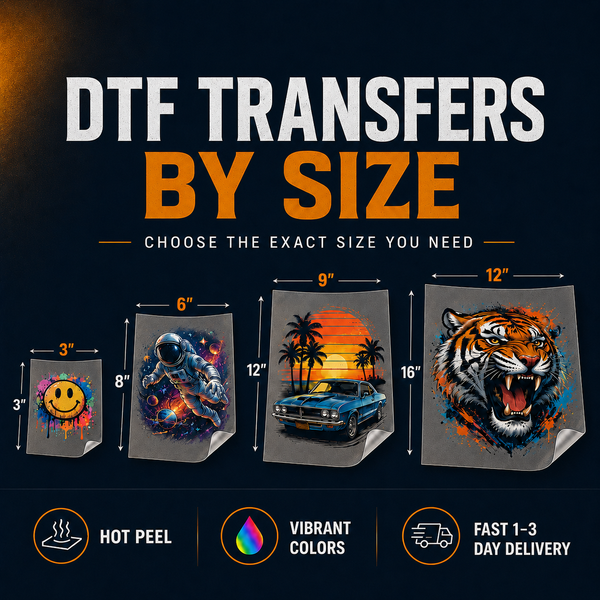
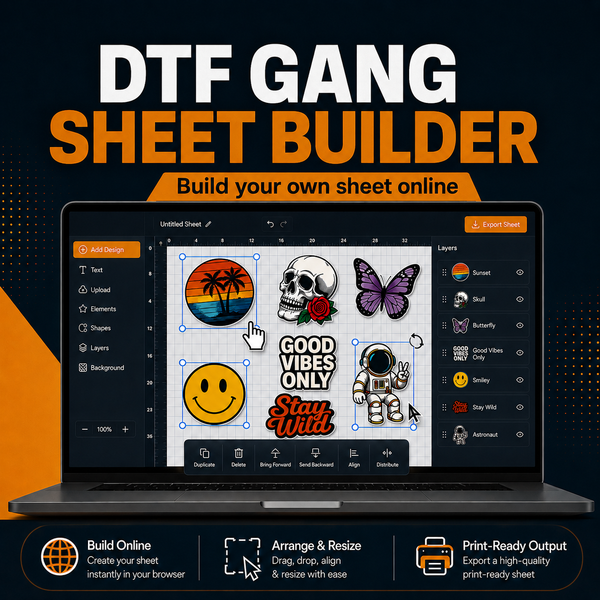
For one logo or a small quantity, you can order DTF transfers by size using the finished dimensions from the chart. For multiple logos, customer names, or size variations, build a DTF gang sheet online and fill unused space with additional left-chest transfers.
If you arrange gang sheets in design software, keep each logo at its actual print dimensions and upload your own ready-made gang sheet. Leave enough cutting space around every design so the production team can separate transfers without trimming into neighboring artwork.
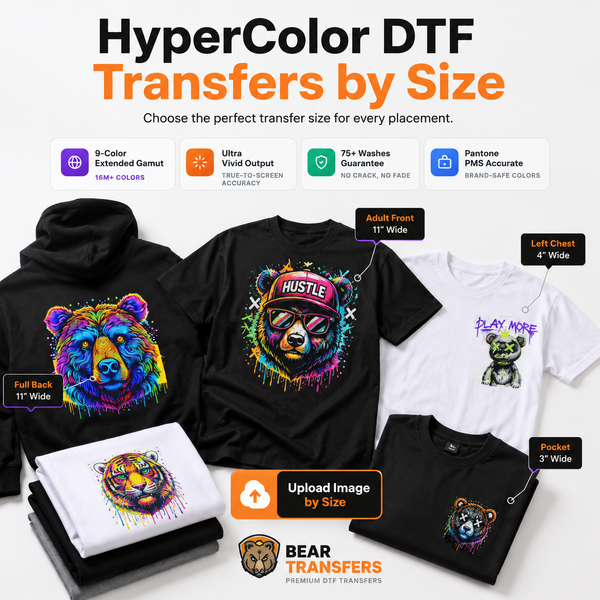
Color-critical brands may benefit from HyperColor 9-color RGB DTF transfers, especially when the left-chest mark includes bright gradients or an expanded color range. Regardless of the transfer option, press one sample on the actual garment before completing a new order.
Pressing Without Losing Your Placement
A correctly measured transfer can still move while the garment is loaded or the press closes. Use a heat-resistant ruler or placement guide, then secure the transfer according to your normal production process. Confirm that the shirt remains square after sliding it onto the platen.
For polos and jackets, seams may prevent the upper platen from applying even pressure. Use a pressing pillow or suitable pad to raise the print area above plackets, zippers, pockets, and heavy seams. The printable panel should be flat rather than stretched.
Follow the transfer’s specified time, temperature, pressure, peel, and repress instructions. Bear Transfers produces hot-peel transfers backed by a 100+ wash guarantee when application and care instructions are followed. Avoid guessing based on settings used for another transfer film or garment.
Before a larger run, press one garment and inspect it while worn or on a form. Confirm the logo sits over the chest rather than too close to the armpit, collar, or centerline. Record the final measurement on the work order so every operator follows the same placement.
FAQ
What is the standard size for an adult left-chest logo?
Use 3.5 inches wide for a standard adult T-shirt. Reduce the width to 3.25 inches for many polos and fitted shirts, or increase it to 4 inches for substantial jackets and wide wordmarks.
How far down should a left-chest logo be?
On an adult crew-neck T-shirt, start with the top of the print 3 inches below the collar. Use about 2.75 inches on fitted shirts and 3.5 to 4 inches on jackets, then check the garment’s seams and construction.
Should every shirt size use the same logo dimensions?
Adult small through extra-large garments can usually share one 3.25- or 3.5-inch logo. Consider a smaller transfer for youth garments and a larger version only for oversized outerwear or designs that look undersized on extended sizes.
Is left chest based on the wearer’s left?
Yes. Left chest means the wearer’s left side, which appears on your right when you face the garment. Confirm orientation before pressing, especially when preparing several shirts at once.
Standardize your approved logo sizes and build a DTF gang sheet online for an efficient left-chest production run.