
DTF vs DTG Printing: Cost, Feel and Durability

DTF and DTG can both produce detailed, full-color apparel, but they solve different production problems. The right choice depends on what you print, how many pieces you sell, which garments you use, and whether you want to own printing equipment or apply ready-made transfers.
For most small apparel businesses, the decision comes down to four factors: total cost, print feel, fabric compatibility, and durability. Here is how direct-to-film and direct-to-garment printing compare in real shop conditions.
DTF vs DTG Printing at a Glance
DTF, or direct-to-film, printing places the design onto a coated film. Powder adhesive is applied and cured, and the finished transfer is pressed onto the garment with heat and pressure. Shops can outsource the printing and keep only a heat press in-house.
DTG, or direct-to-garment, printing sprays water-based ink directly onto the shirt. Most dark garments require pretreatment so white ink can form an opaque base beneath the colors. The garment must then be cured according to the ink system's requirements.
| Factor | DTF | DTG |
|---|---|---|
| Basic shop equipment | Heat press when transfers are outsourced | DTG printer, pretreatment setup, and curing equipment |
| Best fabric range | Cotton, polyester, blends, and many common apparel fabrics | Usually strongest on high-cotton garments |
| Print feel | Smooth transfer layer that is more noticeable on large solid areas | Often softer on cotton, especially with artwork that has open space |
| Small-order workflow | Easy to store transfers and press as orders arrive | Can print one garment at a time but requires active machine maintenance |
| Durability | Excellent when correctly pressed and washed | Good when pretreatment, ink, curing, and garment choice are controlled |
| Color on dark shirts | White underbase supports bright color | Depends heavily on pretreatment and white-ink performance |
Neither method is automatically better for every design. DTG has an advantage when a soft print on cotton is the main goal. DTF is usually more flexible when a shop needs to decorate several fabric types, control inventory, or avoid maintaining a digital garment printer.
Cost: Equipment, Labor, and Per-Shirt Value
Startup and operating costs
An outsourced DTF workflow has a low equipment barrier. You need a reliable heat press, a suitable work surface, and basic alignment tools. You do not need to purchase a DTF printer, run white ink, apply powder, or maintain the printing system yourself.
DTG requires a larger in-house production setup. Beyond the printer, shops must account for pretreatment, curing, cleaning supplies, environmental control, white-ink circulation, maintenance time, and failed prints. A machine sitting unused can still require attention, so purchase price alone does not show the complete cost.
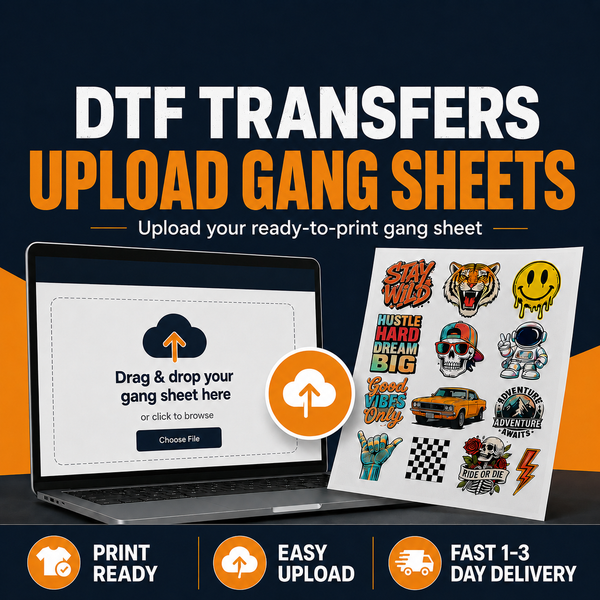
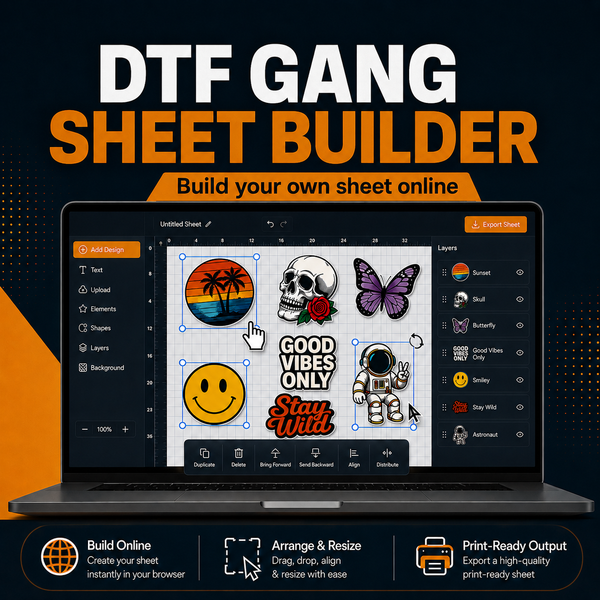
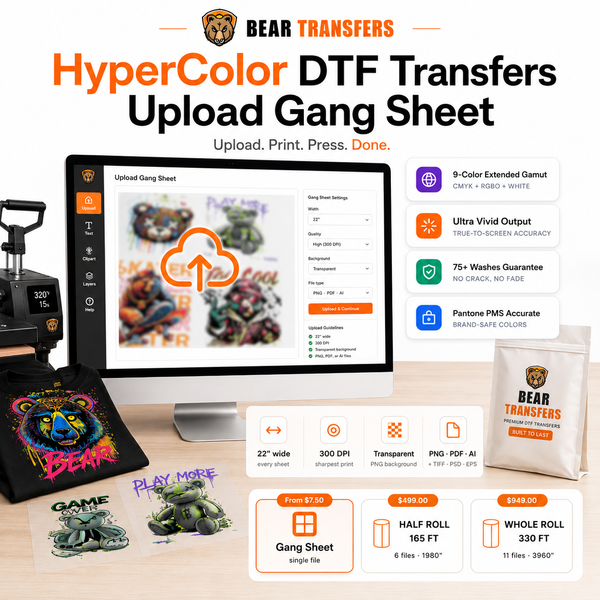
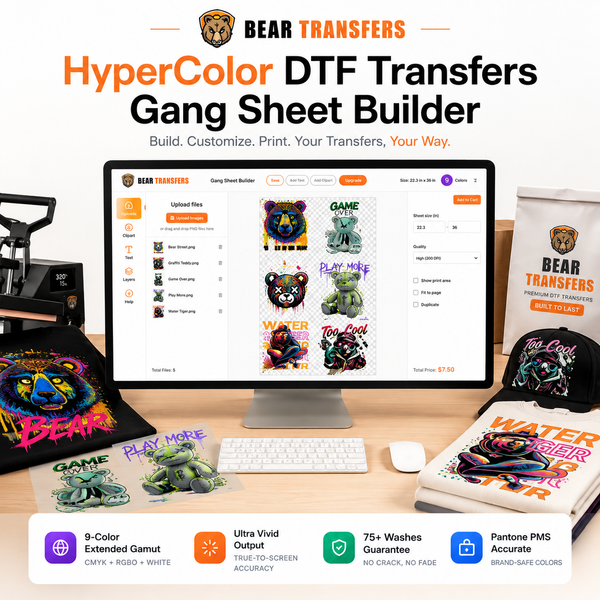
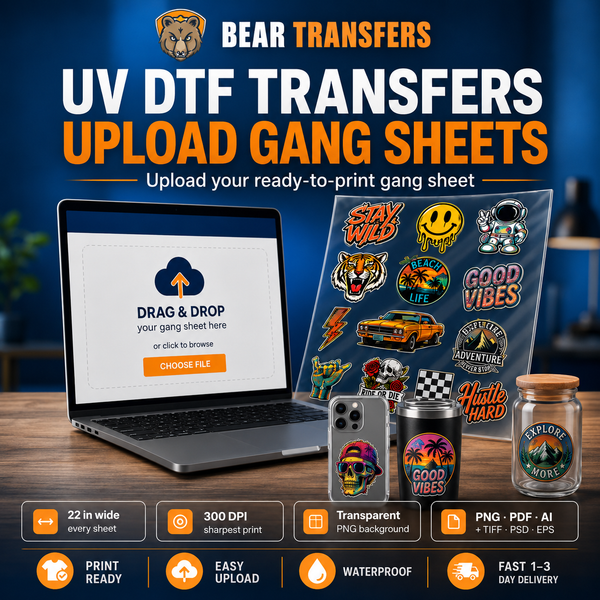
DTF gang sheets reduce unit cost by placing several designs on one length of film. Bear Transfers offers gang sheets starting at $2.58 per foot, allowing shops to combine customer logos, neck labels, front prints, sleeve marks, and reorder designs. You can build a DTF gang sheet online or upload your own ready-made gang sheet if your layout is already complete.
Which method costs less per shirt?
There is no honest universal per-shirt answer. The result changes with design size, ink coverage, garment color, labor rate, spoilage, equipment payments, and sheet utilization.
- DTF is often cost-effective for mixed designs: Fill unused sheet space with small logos, labels, or future orders rather than pricing every design as a separate print run.
- DTF supports print-on-demand inventory: Store transfers instead of finished shirts, then press the required size and color after an order arrives.
- DTG can work well for steady cotton volume: A shop with enough daily demand may spread equipment and maintenance costs across more garments.
- DTG mistakes can be expensive: Incorrect pretreatment, clogged nozzles, poor curing, and garment staining can turn both the blank and the print into waste.
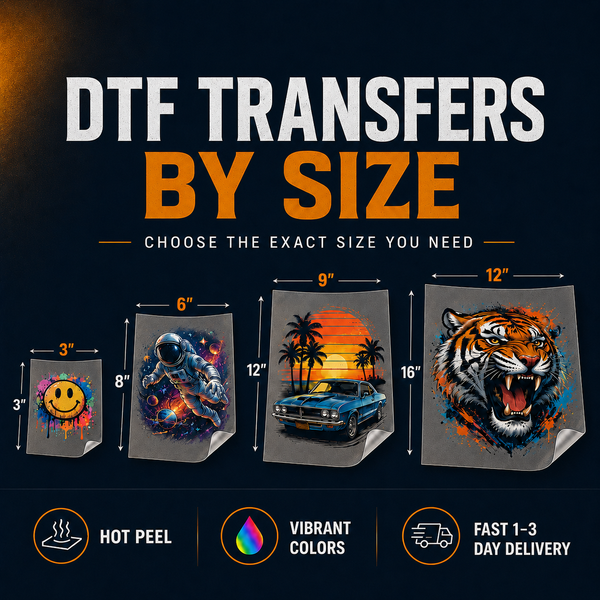
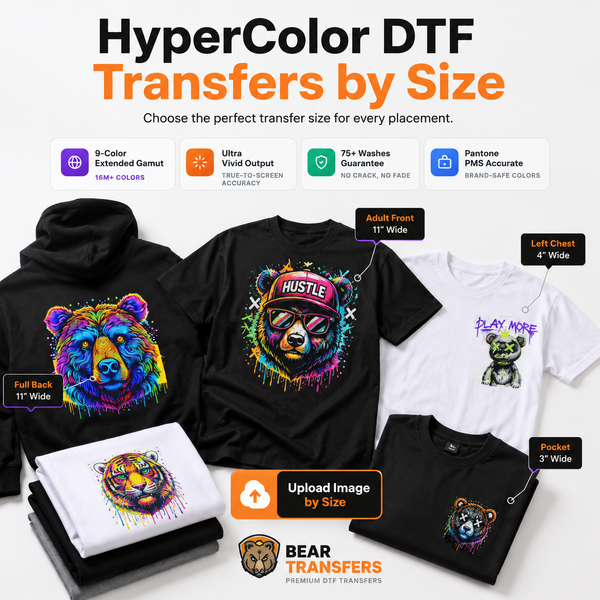
If building a sheet is unnecessary for a small job, you can order DTF transfers by size. Pairing transfers with blank apparel priced near cost can also make job costing simpler for short runs.
Print Feel, Detail, and Color
How DTF feels
DTF sits on top of the fabric as a printed adhesive layer. A small chest logo can feel light and flexible, while a large solid rectangle will feel more noticeable. The artwork itself matters as much as the printing method: removing unnecessary backgrounds and opening negative space lets the garment move and breathe more naturally.
Fine lines and distressed artwork can make a DTF print feel lighter, but details cannot be infinitely small. Thin isolated elements need enough printed area and adhesive to survive handling and washing. Review the guidance in DTF artwork resolution, DPI, file size, and small text before preparing detailed production files.
How DTG feels
DTG ink penetrates the garment fibers, so the finished print can feel especially soft on cotton. This is most apparent on light garments, where white ink and heavy pretreatment may not be necessary. On dark shirts, the pretreatment and white underbase can create a more noticeable printed area, although it generally retains a different hand than a film transfer.
Color and detail differences
Both methods can reproduce gradients, photographs, fine detail, and many colors without screen-printing separations. On dark garments, both rely on white ink to keep the artwork from being muted by the shirt color.
DTF creates that base on the film before application, giving shops a consistent transfer that can be placed on multiple garment colors. DTG results can change with fabric composition, pretreatment amount, printer calibration, and curing. For artwork requiring an expanded color range, HyperColor 9-color RGB DTF transfers add orange, green, red, and blue inks to the standard CMYK and white setup.
Durability and Fabric Compatibility
Durability is not determined by the printing category alone. A correctly produced transfer can still fail if it is pressed with inadequate pressure, while a good DTG print can wash poorly if pretreatment or curing is inconsistent.
Bear Transfers uses hot-peel DTF transfers backed by a 100+ wash guarantee. Correct application remains essential: follow the supplied temperature, time, pressure, peel, and finishing instructions rather than relying on settings from a different transfer supplier. The guide to common heat press mistakes that ruin DTF transfers covers pressure, cold spots, moisture, and repressing.
DTG durability depends on the complete production process. Pretreatment must be even, ink must bond correctly, and the print must receive enough heat to cure without damaging the garment. Because the process is applied directly to each shirt, consistency requires disciplined settings and machine care.
Garment compatibility
DTF is the more versatile choice for shops that regularly switch among cotton, polyester, and blended apparel. It is commonly used for T-shirts, hoodies, workwear, performance garments, tote bags, and other heat-compatible fabrics. Always test unfamiliar or coated items before committing to a full order.
DTG is generally most predictable on high-cotton garments designed for water-based printing. Polyester and some blends can create challenges involving ink adhesion, color accuracy, pretreatment reactions, or dye migration. A DTG shop may therefore need a narrower blank catalog to maintain repeatable results.
Care instructions matter for both methods. Recommend washing garments inside out in cool water with mild detergent, avoiding bleach and fabric softener, and using low heat or air drying. Customers should not iron directly over the decoration.
Which Printing Method Fits Your Business?
Choose DTF when you want to decorate multiple fabric types, accept low-quantity orders, keep transfers ready for future sales, or add apparel without buying a production printer. It is also practical for seasonal sellers that may not print every day.
Choose DTG when soft prints on cotton are central to your product line, you have enough consistent volume to support equipment ownership, and your team can manage pretreatment, maintenance, color control, and curing. DTG can be a strong in-house process, but it is not a maintenance-free shortcut.
For many small brands, DTF creates a simpler order flow:
- Prepare artwork with transparent backgrounds and production-ready resolution.
- Group designs by demand and arrange them efficiently on a gang sheet.
- Order transfers before inventory runs out; qualifying orders placed before the posted cutoff receive same-day production.
- Use 1-3 day UPS shipping options and free shipping on orders over $99 when planning costs.
- Press garments as customer orders arrive rather than stocking every design, color, and size combination.
If feel and finish are deciding factors, test them on the blanks you actually sell. A DTF and UV DTF sample pack lets you inspect print detail and evaluate DTF application before placing a larger order.
FAQ
Is DTF better than DTG for small orders?
DTF is often more practical for a small shop because outsourced transfers eliminate printer ownership and can be stored until needed. DTG can handle one-off shirts, but operating the equipment profitably requires accounting for maintenance, pretreatment, curing, and idle time.
Does DTF feel thicker than DTG?
Usually. DTF forms a flexible layer on the fabric, while DTG ink penetrates cotton fibers. Artwork with negative space, smaller print areas, and fewer large solid blocks can make DTF feel lighter.
Which lasts longer, DTF or DTG?
Both can be durable when produced and applied correctly. DTF durability depends heavily on accurate heat, pressure, peeling, and aftercare; DTG depends on pretreatment, ink quality, curing, garment composition, and washing habits.
Can DTF and DTG print photographs?
Yes. Both methods support full-color images, gradients, and fine details. Start with a high-resolution file, preserve transparency where needed, and avoid details that are too small to print or adhere reliably.
Ready to price your next run? Build a DTF gang sheet online and arrange multiple designs for efficient production.